When is a “new town” not a new town?
While international analysts pick over the combatants’ ambitions in the Iran conflict, Smart Growth UK has been looking at what the Government imagines it’s achieving with its “new towns” policy.
Those inverted commas are significant. Our report examines the New Towns Taskforce recommended sites for 12 “new towns” and finds them to be a bizarre mixture of the greenfield sprawl the Government wants to promote and existing urban regeneration proposals which local government could well progress alone.
The report by the Smart Growth UK coalition, New Towns – The Taskforce’s Strange Mixed Bag, looked at its 12 sites. Six are straightforward greenfield sprawl estates which could, at least theoretically, one day become “new towns”, one is a big greenfield urban extension, and five are straightforward urban regeneration schemes which bear no relation to towns of any sort.
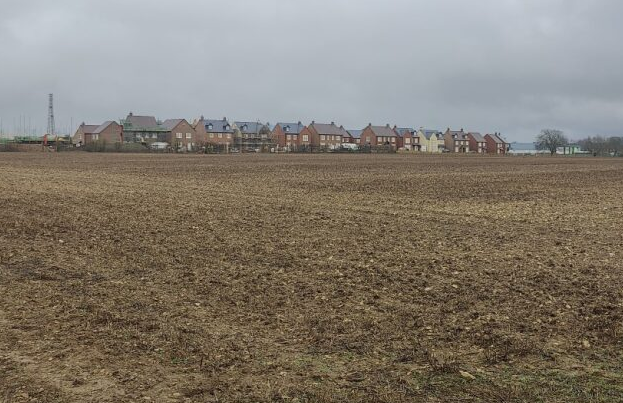
Seven of the “new towns” would involve destruction of productive farmland [Caulcott Area Residents Association]
“The Taskforce decided that ‘new towns’ need not conform to any conventional definition of the term and repeated the myths that planning holds back building and that achieving targets would secure ‘growth’,” says our report. The Taskforce’s definition was simply a large, 10,000+ home development, but only in areas where growth is already strong.
The result was a mish-mash of large housing estates and existing urban regeneration projects or proposals. Nothing in their ideas undermined the conclusions of SGUK’s first new towns report last August that actual new settlements are the slowest, costliest and most destructive way of doing large-scale development.
The Government is expected to define a shortlist in the near future and says it hopes work will be underway on three of them by July 2029. As work is already underway on two or three of the schemes already, this is a remarkably low ambition.
The report contains statements by three of the campaigns fighting the big urban sprawl proposals in their areas – the proposed new towns at Adlington, Chase Park & Crews Hill and Heyford Park.
Those three, along with the proposals at Marlcombe, “Milton Keynes Renewed Town”, Tempsford and “Wychavon Town” would involve large-scale destruction of productive farmland at a time the UK’s lack of food security is raising significant alarm. The report also examined several other plans for large-scale, 10,000+ home estates and found them equally damaging.
Jon Reeds
 Jon Reeds
 Nigel Pearce